
Press conference material
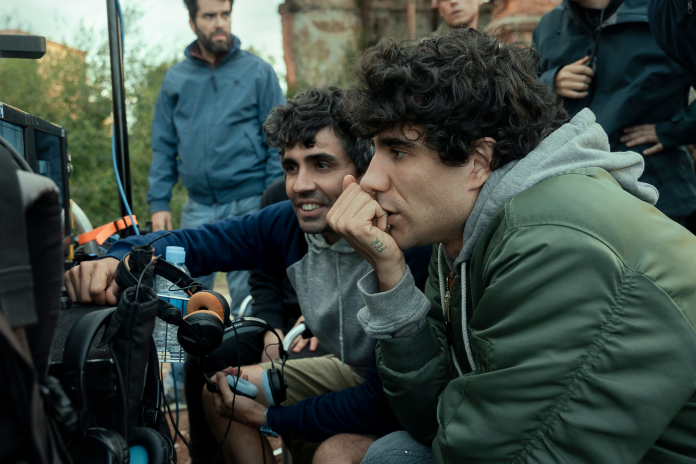
Spanish filmmakers Javier Ambrossi and Javier Calvo, collectively known as Los Javis, explore the legacy of Federico García Lorca and the stories that history left unfinished in their film La Bola Negra (The Black Ball). Having won Best Director at the Cannes Film Festival and received audience recognition at international festivals, the film has resonated with viewers far beyond Spain. During an international press conference, the directors discussed the power of queer storytelling, personal experiences of rejection, working with Glenn Close, and why they wanted audiences to imagine their own endings.
Your film is deeply rooted in Spanish culture and literature. Why do you think it resonates so strongly with international audiences, particularly in the United States?
Javier Calvo: I think this movie is an emotional journey. It’s a love story, a movie about humanity and empathy, which I think is something we really need right now, not only in our country but all over the world. It’s about seeing and understanding another person, not as an enemy but as a human being. Hate and intolerance are shadows hanging over us. When you really get to know Sebastián, Rafael, Carlos, and Alberto, and when you feel their pain, you don’t want anything bad to happen to them. That’s the power of art. It creates empathy.
Your film explores a time when living authentically could come at a terrible price. What do you hope younger LGBTQ+ generations will take away from this story?
Javier Ambrossi: To me, La Bola Negra represents the shame you can feel about yourself. I can still feel the rejection I experienced as a child in my own body. I notice it in my shoulders, in my voice, and in the moments when I find myself trying to appear more masculine. Sometimes, when I’m walking down the street and see a group of boys playing football, I feel scared. I don’t even know why. That black ball is something I can still feel every day. I would love this movie to make that black ball smaller for the next generation. It’s already doing that for me. I also hope people see that a movie written and directed by two gay men, exploring the gay experience and featuring gay actors portraying gay characters, can succeed at the box office.
You don’t have to change a queer story to reach a wider audience. It can be raw, truthful, and authentic to its creators. Hopefully, that encourages the next generation of queer people and filmmakers to tell their own stories.
Was it important for you to demonstrate that LGBTQ+ stories can be universal rather than being considered niche?
Javier Ambrossi: Absolutely. We wanted to make the biggest, gayest war movie ever. We wanted to prove that LGBTQ+ stories aren’t supposed to be niche. They can be universal, and we’re happy that we’re getting there. We’re receiving so much love from our community, and we love them back. We’re really committed to continuing to write stories for them.
The film was inspired by just four unfinished pages of Federico García Lorca’s work. How did you approach developing a complete screenplay from such limited material?
Javier Calvo: There were only four pages. Two of them contained a list of characters Lorca wanted to portray, including the mother, the father, Carlos, Enrique, and Lorenzo. He wanted to create a realistic drama with a gay main character. In El público, he had explored homosexuality through symbolism, but here he wanted to do something revolutionary: create a gay character in a realistic story for everyone. Then the list became more mysterious, with characters such as the skiers and the snow.
The other two pages contained a scene with the sister, who says that because she’s a woman, she cannot go outside or climb trees as a man could. Everything else was created by us and our co-writer, Alberto Conejero. But we were constantly searching for clues about what Lorca might have wanted to do. Snow often represents death in his work. The moon and the snow are characters that speak to the protagonist about death. We also discovered interviews that helped us understand some of the events and scenes he might have imagined. We did a lot of research because we wanted to approach his work respectfully. But we don’t feel that we’ve finished Lorca’s play. We simply imagined what it might have been.
Glenn Close also appears in the film, delivering her performance in Spanish. How did you convince her to take on that challenge?
Javier Ambrossi: She didn’t speak a single word of Spanish! One night, around three in the morning, we received an email with a PDF attached. It was a beautiful letter from someone explaining how much they loved our previous television series, La Mesías. And that someone was Glenn Close. We were incredibly surprised and honored. We started talking about possible projects and eventually became friends. When we were writing La Bola Negra, we needed someone who could bring warmth to a role involving a lot of historical information. Glenn came to mind. We sent her the script and told her that if she connected with it, we should make the film together. She loved it and said yes. Then I told her the film was in Spanish. She said she would do it in Spanish. I asked whether she spoke the language. She said she didn’t speak a word but was willing to learn whatever it took to make the film special. It was a huge challenge, and she was scared. You have to be incredibly brave to perform in a language you don’t speak.
I think she did it because she loved the message of the film. It was also an act of love toward our language. What she did was brave and vulnerable, and I’ll always be grateful.
Javier Calvo: She’s such an extraordinary performer that you genuinely believe she’s a historian who knows Spanish better than Spanish people do!
We even sent a Spanish teacher to the set of The Hunger Games in Germany. Imagine Glenn in her Hunger Games costume, learning Spanish while waiting to shoot her scenes. It was incredible.
The film has received international recognition, including the Best Director award at Cannes. What has this journey meant to you personally and professionally?
Javier Calvo: When we were in the editing room, we didn’t even know whether we would finish the film in time for Cannes. We spent months working with our editor, Alberto Gutiérrez, who kept encouraging us and telling us that we would make it and that the film would be worth it. Eventually, we finished the movie, submitted it to Cannes, and were selected for the Official Selection. Suddenly, we were walking the red carpet. And then, almost before we could process what was happening, we had won Best Director. Sometimes these things happen when you’re ready, and sometimes they happen when you’re not.
Looking at our actors now, seeing them here at this press conference, some experiencing all of this for the first time, makes me incredibly proud. They understand the message of the movie, they communicate it beautifully, and they share our passion for it. I’m proud of my team, proud of my movie, and proud of myself for being able to enjoy every step of this journey.
The film begins in 1930s Granada, where a young gay man is rejected by a social club. Do you think the story takes on a different meaning in the United States, where LGBTQ+ rights are once again part of the political debate?
Javier Ambrossi: What surprises me is that the movie seems to create the same emotional response everywhere. I think that means the LGBTQ+ community around the world has, at some point, experienced something similar to what happens to that young man at the casino. We’ve all been there, in front of that black ball. That’s why I think audiences are responding to the movie in such a similar way, regardless of where they’re from.
You built a film around Lorca’s unfinished work, but you also deliberately left several storylines unresolved. Why was that important?
Javier Ambrossi: All three storylines are unfinished, and that’s exactly what we wanted. We want the audience to be the ones who continue the characters’ journeys. This is a movie about the unfinished. Our rights and freedoms are built on so much silence, so many deaths, and so much injustice. We wanted to speak to contemporary audiences and remind them of that history. I want viewers to continue the journey by at least trying to be happy and trying to live a life they can be proud of. We wanted to make a movie about the unfinished in order to give people hope.