
Press conference material
Before “La Gradiva,” you primarily worked as a cinematographer. What inspired you to move into directing?
I had wanted to direct for a long time. Over the past ten years, while working as a cinematographer, I also made short and medium-length films. For several years, I had been writing a feature screenplay, but the process was proving difficult.
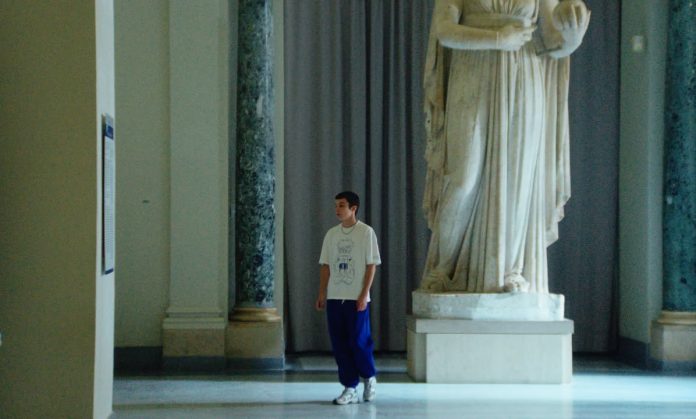
Then a producer approached me with the idea of making a film about adolescence using non-professional actors. Quite quickly, I came up with the idea of bringing together the world of teenagers and the ruins of Pompeii. Once that idea emerged, the writing process became much easier.
Why did you choose Pompeii as the setting? Which filmmakers inspired you?
Southern Italy, Naples, and Pompeii are deeply connected to cinema history. It is impossible not to think of Roberto Rossellini. Surprisingly, however, I was also inspired by New Hollywood, particularly when developing Tony’s character. The actor and I talked a lot about Robert De Niro and Al Pacino.
While making the film, I also thought about the French tradition of improvisational filmmaking. I realized that achieving genuine spontaneity requires a great deal of preparation and rehearsal.
I wanted the film to begin in a naturalistic, almost documentary style, before gradually moving toward something more lyrical and emotional. In this respect, I was inspired by the melodramas of Douglas Sirk and Rainer Werner Fassbinder.
Many of the actors in the film are non-professionals. How did you discover them?
The casting process lasted two years. I wasn’t looking for young people who could act perfectly. I wanted strong, distinctive personalities. I wanted audiences to believe they were watching a real school class.
We searched for actors outside schools, in amateur theater groups, and at demonstrations. We met Mitya during a May Day protest. I was fascinated by his charisma, androgyny, and political activism. His personality actually influenced the development of his character, giving him a stronger political perspective.
I met Kola during a school trip. He had a nonchalant attitude and enjoyed inventing stories, but there was also a certain melancholy about him. That reminded me of Tony. Later, I discovered that he had studied dance for ten years. I think acting became a natural continuation of his relationship with movement and physical expression.
Family history and the search for the past play important roles in the film. How much of your personal experience is reflected in the story?
My father was born in Tunisia, and my grandfather was born in Algeria. I have never known Tunisia myself, so I have a particular relationship with these unknown roots, almost like a lost paradise.
My family history consists of stories that were sometimes exaggerated and dramatic. My grandmother would describe my father’s exile as a story that could make you cry, but that was ultimately beautiful.
Yet behind these beautiful stories lies class violence and the violence of colonization. What interested me was what remains hidden behind family narratives. What do we choose not to say? What is simply too painful to express?
What is the meaning behind the title “La Gradiva”?
The title comes from a story by Wilhelm Jensen about an archaeologist who becomes obsessed with a bas-relief depicting a walking woman.
I discovered this story through Sigmund Freud, who used Pompeii as a metaphor for the unconscious.
What fascinated me was how a single image could contain an entire fiction while also revealing a certain degree of truth. This connects to the film’s themes of memory, obsession, and denial.
I also wanted the film to be accompanied by a mythological figure, someone who carries the sense of fate and inevitability.
How would you like young audiences to respond to the film?
While making the film, I wasn’t thinking about whether it would become a generational film. Questions like that can be overwhelming. I wanted to focus on the story I genuinely wanted to tell.
But now I see that young people in France and other countries recognize themselves in it. They thank me for portraying adolescence seriously, without turning teenagers into caricatures.
I hope the film will touch people regardless of their cultural backgrounds because it deals with emotions we have all experienced during adolescence.
The film is being released at a time of youth protests in France. Do you see a connection between the film and these movements?
We spent five years writing the film, trying to understand the lives of young people. We spoke with students after the COVID lockdowns, met teachers, and observed their environment.
Today, young people are trying to reclaim a future that has seemed increasingly out of reach in recent years. They are demanding equal opportunities and decent educational conditions.
I believe the film reflects this particular moment in history. Despite the atmosphere of disaster and chaos surrounding us, there is still a living, joyful impulse of rebellion.
That is something I wanted the film to capture.