
Press conference materials
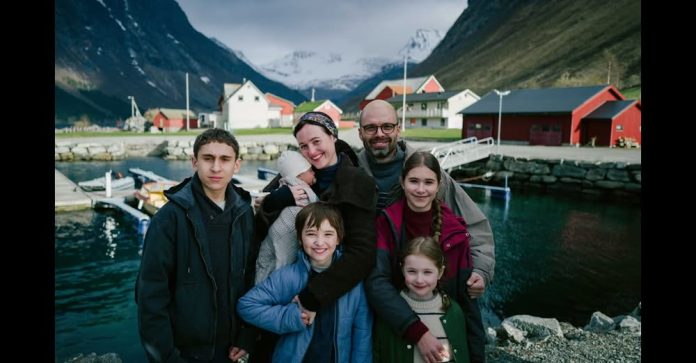
Romanian filmmaker Cristian Mungiu’s “Fjord” explores the clash between traditional family values and modern society. Starring Sebastian Stan and Renate Reinsve, the film raises difficult questions about immigration, parenthood, religion, and the limits of state intervention in family life. During an international press conference, the director and his leading actors discussed the film’s themes, their personal experiences, and the challenges of bringing this complex story to the screen.
– Sebastian, your character Mihai loves his family, yet his beliefs often clash with the world around him. How did you approach this contradiction?
Sebastian Stan: My own background helped me a great deal. I grew up in Romania until I was eight, in a very traditional environment, and I later became an immigrant myself. I also drew inspiration from Romanian men I had known. Eastern European men are often stereotyped as emotionally reserved, but just because someone doesn’t openly express their feelings doesn’t mean they don’t deeply care about their family. Working with Cristian, it was important not to manipulate the audience’s perception of Mihai. We wanted viewers to decide for themselves whether he is a good or a bad father.
– This film also allowed you to reconnect with your Romanian roots. What do you remember about your own immigrant experience?
Sebastian Stan: When I first came to the United States, I was told it would be better not to tell people where I was from. I was encouraged to fit in, make friends, and avoid drawing attention to what made me different. For a long time, I felt a strange sense of shame about my background. I felt I couldn’t really talk about it. Only later did I begin to understand how important it was to know where I came from and how much that was part of who I am. I’d always dreamed of finding a film that would allow me to reconnect with that part of my past. “Fjord” gave me that opportunity.
– Cristian, why did you choose Norway as the setting for this story?
Cristian Mungiu: In my previous film, “R.M.N.,” I explored a conservative majority struggling to accept minorities. With “Fjord,” I wanted to reverse that situation and examine what happens when a conservative minority finds itself in a very liberal and progressive society. Scandinavian countries are often seen as among the most educated and progressive societies in the world, which makes this conflict particularly interesting. We tend to think we’re all living in the same century, but people’s cultural and historical experiences can be very different. We cannot expect families arriving from more conservative societies to immediately adopt every value of a progressive society. These changes take time, and we need to approach them with empathy.
– Renate, your character Lisbet deeply loves her children, yet her parenting methods are questioned. How did you understand her?
Renate Reinsve: I believe Lisbet deeply cares about her children. She’s an incredibly empathetic and compassionate person whose life is shaped by her relationship with God and her family. What fascinated me was her ability to maintain that compassion even when her values and actions were being questioned. She’s also capable of looking at herself critically and changing her perspective. I found it particularly interesting to play someone whose intentions may be good, but whose actions can be interpreted very differently by others.
– Cristian, the film addresses the controversial issue of removing children from their families. Where should the line be drawn between protecting children and imposing a particular model of parenting?
Cristian Mungiu: If violence within a family is proven, there is no question that the authorities must intervene and protect the children. But beyond that, we need common sense and an understanding of individual circumstances. You cannot simply apply the same rules to every family without considering their cultural background and values. People don’t change their beliefs just because they’re forbidden from expressing them. We need dialogue, education, and understanding rather than forcing our values onto others.
– Sebastian, how was working with Cristian Mungiu different from your experiences on major Hollywood productions?
Sebastian Stan: Cristian’s films feel incredibly real, almost as though you’re watching life unfold rather than something carefully constructed. But achieving that naturalism requires an enormous amount of work. Every scene is filmed in one long take, and sometimes we would do thirty or forty takes. It demands a completely different kind of concentration and commitment from an actor. I was also drawn to the questions the film raises about fatherhood. What does it mean to be a father today? How do our traditions influence us, and how do we pass them on to our children? Those are questions I don’t necessarily encounter in major Hollywood films.
– Cristian, why was it important not to clearly distinguish between the characters who are right and those who are wrong?
Cristian Mungiu: Because in real life, people are never simply good or bad. While researching this story, I spoke with parents, children, lawyers, child protection representatives, and journalists. Yet even after extensive research, I couldn’t say with certainty what had actually happened within that family. I wanted to respect that complexity and allow audiences to make their own judgments. We all interpret situations through our personal experiences, values, and prejudices. My hope is that viewers leave the cinema thinking not only about the characters but also about their own beliefs and assumptions. Cinema doesn’t always need to provide answers. Sometimes its greatest value lies in encouraging us to ask questions.