
Tie2.lt
On November 7 – December 7, 2024, an exhibition of works by Laisvydė Šalčiūtė titled The Bestiary will be on display at the Titanikas exhibition halls (2nd floor) of Vilnius Academy of Arts. The opening will be held on November 7, 2024, at 6pm.
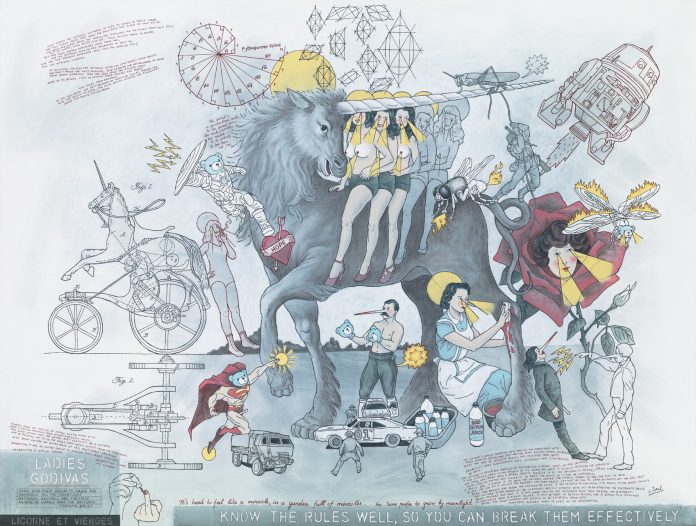
In her series The Bestiary, the artist Laisvydė Šalčiūtė interprets the Anthropocene era, in which we all live, through the prism of medieval bestiaries and Renaissance cabinets of curiosities. According to the author, in our epoch humankind has become a radical force that alters not only its own but also other lifeforms’ fate and structure. Yet the artist approaches this phenomen (self-)ironically, as an expression of human POWERLESSNESS rather than human power. In these works she tells stories of ECO-ANXIETY, questions and ironically visualizes the binary of CULTURE VERSUS NATURE and provokes the viewer to ponder the paradigms of politics, war and biophilosophy. Šalčiūtė’s creative practice is based on the methods of artistic appropriation and fiction as tools that are capable of paradoxical coupling of digital images found on the internet with visual and verbal elements of different contexts and epochs, as well as with classical aesthetics. The artist encourages the viewer of The Bestiary to consider a non-hierarchical appreciation of all forms of life and the possible ethical, moral and artistic interdependences it entails.
The curator of the exhibition Laima Kreivytė claims that Laisvydė Šalčiūtė’s The Bestiary is an inverted zoo. Biped and quadruped creatures graze on canvas and paper, observed by the all-seeing eye of an ape. Or an elephant. Or a lion. Or a viper. Or a swan. Or-or-or-or. Animals from medieval bestiaries and the artist’s imagination, mythical accounts and the expanses of the Internet. They cry crocodile tears and cuckoo from broken clocks, show the middle finger to the homo sapiens who have come to the exhibition and pierce them with their gaze akin to a golden scalpel. It is a 21st century bestiary in which chimeras have turned into hybrids and centaurs have become quadrobers. The Little Red Riding Hood is hoodless and saint Wilgefortis is beardless.
How should one view this exhibition? From up close and from a distance. Flying by the works like a comet so that they start to spin like celestial bodies in a space movie. But the best way is to stick one’s nose into a work (at a distance of Pinocchio’s nose) and explore the miraculous world of flora, fauna and the virtualised humankind. Since every work contains numerous scientific, esoteric, mythical, religious, literary and artistic references that paradoxically blend into a meaningful narrative.
Curated by Laima Kreivytė
Exhibition architecture by Ieva Cicėnaitė
Coordinated by Jurga Minčinauskienė
Design by Laura Varžgalytė
Copy editing by Audra Kairienė
Translation by Jurij Dobriakov
Video editing by Mantas Talmantas
Organised by Vilnius Graphic Art Centre
The exhibition is funded by LATGA Association and Lithuanian Council for Culture
With support from Druska Miltai Vanduo Bakery
Partners: Vilnius Academy of Arts, VAA Titanikas exhibition halls
Media partners: artnews.lt, 7 meno dienos
For more information: +370 210 0136, +370 5 261 1995, graphic.lt
Opening hours: II–VI 12–18 val.