
Press Conference Material
An interview with director Ryusuke Hamaguchi and actresses Virginie Efira and Tao Okamoto
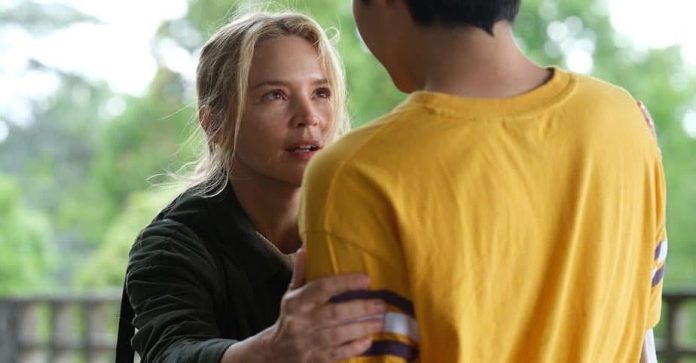
Golden Globe and Academy Award-winning Japanese filmmaker Ryusuke Hamaguchi explores loneliness, friendship, mortality and the extraordinary power of human connection in his film “All of a Sudden.” Presented at the Cannes Film Festival, the film earned its two leading actresses, Virginie Efira and Tao Okamoto, a joint Best Actress award.
Although the film addresses profound existential questions, its creators invite audiences to reflect not so much on death as on life itself, the importance of listening and the hope we can offer one another.
During a press conference, the director and his leading actresses shared their thoughts on the creative process, the perception of time, the significance of silence in cinema and the remarkable connection they developed during filming.
Ryusuke, how would you describe “All of a Sudden”? Why does it leave audiences feeling so hopeful despite its difficult subject matter?
Ryusuke Hamaguchi: Ultimately, I think this is a film about the life force, or the energy of life. That is something I received from the original material I was adapting.
The two women in the film talk about many different things, but it is their conversations that truly connect them. Through that connection, we receive a certain energy and power for living.
It is something that goes beyond the words being expressed. I experienced that same feeling while editing the film, and I was moved by it myself. So I am very happy to hear that audiences are experiencing something similar.
Virginie and Tao, the film features long, uninterrupted conversations. Was it intimidating to take on the responsibility of making so much dialogue feel natural and authentic?
Virginie Efira: Long scenes give you the opportunity to observe many details. Everything you look at long enough becomes interesting.
For us, it was an opportunity to truly live in the moment, experience the emotions and embrace the unpredictability of reality. We come from different cultures and speak different languages, but these long scenes and Ryusuke’s approach allowed us to feel things from within.
I did not want simply to perform. I wanted to be with Tao and really listen to her. And listening to her was so easy.
Perhaps if you are good at listening, you are also good at acting. The relationship we developed on set became an important part of our characters’ relationship.
Tao Okamoto: The amount of dialogue could initially have been intimidating, but Hamaguchi allowed us to prepare very carefully. He never left us alone to memorize all those words. He worked through the scenes with us, and we rehearsed every day, even after filming had begun.
I saw how dedicated Virginie was to learning a new language. I only knew a few French phrases myself, so we went through this journey together and supported each other.
I remember one of my favorite scenes by the River Seine. One day, Virginie took my hand, pressed it against her heart and asked me to listen to how fast it was beating.
It was touching to see how much effort she was making, despite being such an established actress. In the end, I was no longer afraid of performing those challenging scenes.
Ryusuke, the perception of time plays a significant role in the film. How did this theme influence your cinematic approach?
Ryusuke Hamaguchi: The idea of time was already present in the original material, an exchange of letters between a cultural anthropologist and a philosopher. The two had barely met, and their relationship was largely built through their correspondence.
Despite the relatively short time they had known each other, they developed an extraordinary depth of connection. They themselves were surprised by this and began questioning what time actually is.
Time as we experience it is not necessarily linear or something measured by a clock. There is also a depth to time. I wanted to express that feeling through the film.
I used long takes to explore how the relationship between the two characters develops through conversation. I was also very conscious of the changing light. In the Kyoto scene, for example, I condensed approximately two hours into seven minutes.
I wanted audiences to experience time as these two women were living it, beyond our ordinary, everyday perception of time. I felt that this was something cinema could uniquely express.
Silence carries considerable dramatic power in Hamaguchi’s films. How did you approach silence as actresses?
Virginie Efira: I do not think you can approach silence before you have heard it. It is not an intellectual process.
When you are truly inside a scene, when you are really with Tao, or when you are in Japan looking at the mountains and watching the sunlight fall across her face, you may feel that silence is the best way to communicate.
Silence is like music. If you are attentive to everything around you – to the other person, the trees, the people nearby – silence emerges naturally.
Tao Okamoto: I agree. It is not something we can calculate. Some of it probably also happens in the editing room.
The script does not necessarily tell us the precise tempo of the dialogue or where we should pause. Silence comes organically, sometimes unexpectedly.
As an actress, I did not consciously try to create those moments. I allowed them to happen.
Ryusuke, theater and live performance appear in several of your films. Why does this art form resonate so strongly with you?
Ryusuke Hamaguchi: Initially, I did not want to incorporate theater into this film. Having already made “Drive My Car,” I did not want to be perceived as a director who always includes theater in his work.
However, Makiko Miyano, one of the authors of the original material, had been involved in theater during college and had left behind notes on theater directing.
I realized that theater could create a naturally profound encounter between two people. A theatrical production is an independent work of art that can contain much of its creator’s inner life.
By experiencing Mari’s theatrical work, Marie-Lou can gain a deep understanding of her within a relatively short period of time.
I have also discovered that theater within cinema allows actors to express themselves as actors. There is an almost explosive creative power in that, which I have experienced while directing such scenes.
The film explores a more humane approach to patient care. Do you believe such an approach is possible in contemporary society?
Ryusuke Hamaguchi: There is no real need to try to believe in it, because Humanitude already exists as a care technique. It originated in France and is being used around the world, including in Japan.
Of course, as we see in the film, there are circumstances that make implementing this approach difficult. It is not easy, but it is possible because it is already happening.
I think that, just as in the film, change has to happen one step at a time.
Virginie and Tao, there are many unspoken layers to the relationship between your characters. How did you develop such convincing chemistry?
Tao Okamoto: I was very fortunate that my scene partner was such a lovable and charming person. I did not have to work on liking her.
What we experienced as actresses was somehow mirrored in the story itself. We were able to shoot almost everything in chronological order, so we gradually discovered each other alongside our characters.
I remember the scene by the river in which Mari talks about her experience with cancer. I felt that I could trust Virginie not only as an actress but also as the woman sitting in front of me.
As my character shared her life story, I eventually found myself sharing my own story with Virginie. I had not planned to do that.
It was something of a miracle. I am grateful to Hamaguchi for casting us both and to Virginie for being who she is.
Virginie Efira: I feel exactly the same way. We met and discovered each other during filming. I do not know whether fiction became reality or reality became fiction.
Ryusuke prepared questionnaires for our characters. They included philosophical, social and deeply personal questions about our relationships with our mothers, sexuality and other subjects that were not necessarily directly connected to the film’s plot.
However, we never asked each other about our answers. We were constantly discovering one another.
Speaking different languages also made us more attentive to body language. We knew we were experiencing something special, not only as actresses but also as human beings.
This film explores something very profound about what it means to be alive. We knew we were sharing an experience that would never be erased.
Ryusuke, what particular qualities led you to cast Virginie and Tao in the leading roles?
Ryusuke Hamaguchi: The simplest answer is that they are both wonderful actresses and wonderful human beings.
I was already familiar with their previous performances, but the casting process gave me the opportunity to get to know them better.
Virginie has an extraordinary presence and energy. She approaches her roles head-on and immerses herself in them completely.
Tao is more soft-spoken, yet she was able to convey how important this work was to her in a way that no one else could have done.
Their intelligence was also important because they needed to be convincing as characters with academic backgrounds. Through my conversations with them, I realized that these were the two people I wanted to work with.
Death and dying are portrayed with remarkable tenderness in the film. Why did you choose such a gentle and hopeful approach?
Ryusuke Hamaguchi: It is very much rooted in the original material. The exchange of letters between the two women, which eventually became a book, has a definite conclusion. Makiko Miyano passed away a few weeks after they completed the book.
In that sense, death itself is not directly present in the original material. What you really feel instead is the power and the will to live.
Of course, there is an awareness of approaching death throughout the work. But there is also another human being who can soften that final departure. Someone who remains close and stays with the other person until the very end.
I believe that such a relationship has the power to transform even that period of time into something meaningful and fulfilling.
These two actresses conveyed that beautifully, reaching a level of expression that goes beyond words.